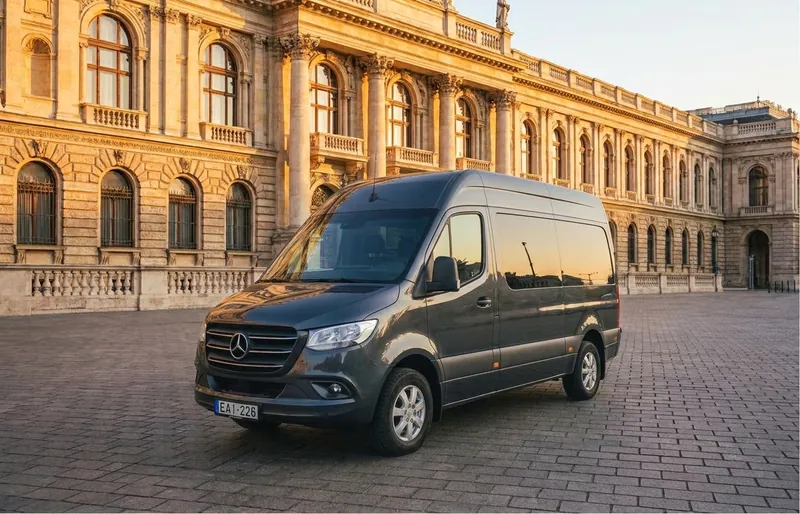
Eco / Luxury · electric
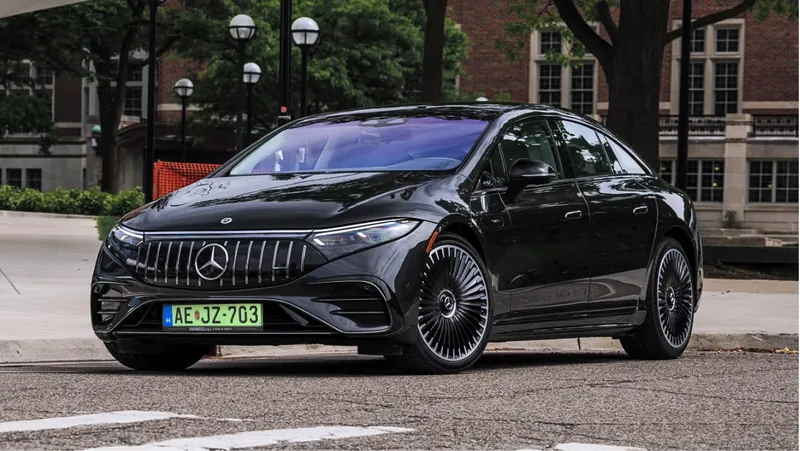
Mercedes-Benz EQS
- 3 passengers
- 3 bags
- free Wi-Fi
- 100% electric
€199 / transfer (incl. tax and parking)
€125 / hour (incl. tax)
Protecting the environment has been a core value for us for decades – with electric cars and minibuses.
Choosing a vehicle from our electric fleet does not make your journey any less comfortable or any less elegant – only quieter, and free of exhaust fumes wherever it goes. Our two electric vehicles, the Mercedes-Benz EQS luxury sedan and the Peugeot e-Traveller minibus, cover the full range of premium chauffeur-driven travel with zero local emissions, from one passenger up to seven.
For us, looking after the environment is not a passing trend: it has been a core value for decades. That is why our fleet includes 100% electric cars and minibuses, and why our base has been extended with a solar park and several electric vehicle chargers. On this page, we summarise what the two vehicles offer, what zero local emissions mean in practice, what to bear in mind on a longer journey, and why an electric vehicle can also be a good choice for a company’s sustainability goals.
Fleet
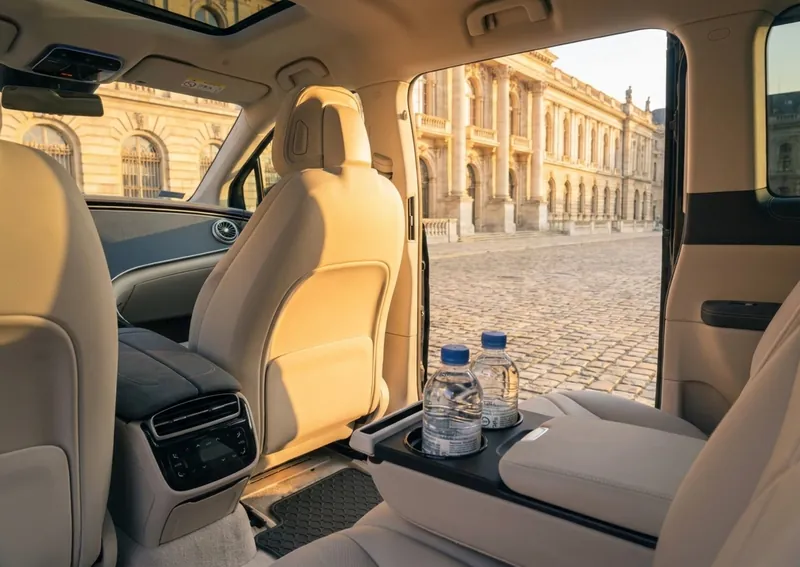
The two vehicles complement each other well: the EQS is for the distinguished guest, the executive and the special occasion; the e-Traveller for the family, the team and the group. Both have free Wi-Fi, and mineral water awaits every passenger.
Eco / Luxury · electric
€199 / transfer (incl. tax and parking)
€125 / hour (incl. tax)
Eco · electric
€149 / transfer (incl. tax and parking)
€95 / hour (incl. tax)
Mercedes-Benz EQS
The EQS is the electric member of our fleet’s top class: up to three passengers and three pieces of luggage, €199 per transfer (including tax and parking) or €125 per hour (including tax) – exactly the same as the conventionally powered S-Class. Thanks to its long range, you can travel comfortably to any part of the country or across the region.
Some background on the model: Mercedes-Benz unveiled the production version of the EQS on 15 April 2021, the brand’s first EQ model built on a platform developed specifically for electric vehicles. According to the manufacturer, with a drag coefficient of 0.20 it was the production car with the lowest aerodynamic drag at the time of its launch – which, in practice, means less wind noise at higher speeds. Details on the Mercedes-Benz EQS page.
Peugeot e-Traveller
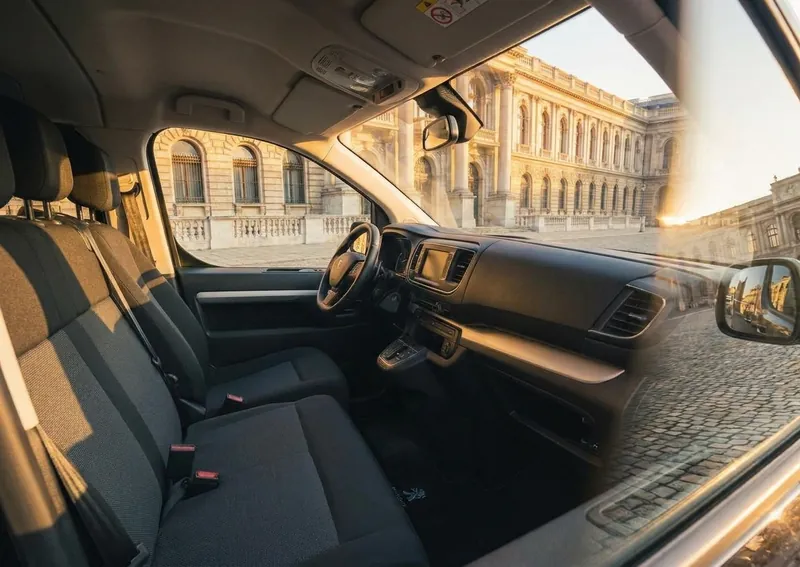
The e-Traveller carries up to seven passengers and seven pieces of luggage, with 100% electric drive, zero local emissions and very little noise. Its price is €149 per transfer (including tax and parking) or €95 per hour (including tax), making it the best value of our seven-passenger vehicles.
It comes into its own when your party is larger than a sedan can hold, but travelling with zero local emissions also matters: for family airport arrivals, sightseeing, corporate programmes and transport for smaller delegations. Details on the Peugeot e-Traveller page.
Our base
An electric fleet is only truly consistent if at least part of the energy used for charging comes from a clean source. That is why our base has been extended with a solar park and several electric vehicle chargers: our electric vehicles can be charged in our own yard before and after the day’s work.
This has two benefits. First, each vehicle can set off on its first journey of the day with a fully charged battery, and charging does not take up passengers’ time. Second, the electricity generated by the solar panels reduces the amount of grid electricity we use – because the overall environmental footprint of an electric car also depends on the source of the energy it is charged with.
Definitions
A fully electric vehicle has no exhaust pipe, so wherever it travels it emits no exhaust gases: no carbon dioxide, no nitrogen oxides, no soot. That is precisely what “zero local emissions” means – the vehicle does not pollute the air where it is being used.
This matters most in the city. An electric vehicle waiting outside a hotel entrance, in a city-centre street, in front of the airport arrivals hall or in the courtyard of an event venue does not burden the air of the people around it. At the same time, the term does not mean that the vehicle’s entire life cycle is emission-free: manufacturing the battery and generating the electricity both have an environmental impact. That is why it is important to use as much renewable energy for charging as possible – and this is where the solar park at our base helps.
In short: an electric vehicle emits no pollutants where it is used, while its overall environmental footprint is determined by the source of the energy used to charge it. We work on both sides: with electric vehicles and with our own solar park.
The passenger’s view
Within a few minutes in the cabin, the technical differences become a tangible experience. Most passengers first notice the silence, then how smoothly the car moves off and comes to a stop. After a long flight or a tiring day of meetings, this calm is worth more than any extra feature – and anyone who has travelled this way once knows what to look for when choosing a vehicle next time: not horsepower, but the feeling of a calm, undisturbed journey.
No engine noise, no idling, no vibration. A phone call, a quiet conversation or a short rest between two meetings is undisturbed – and the EQS’s outstanding sound insulation adds to this further.
With electric drive, there are no jolts from gear changes, and acceleration and braking are even. Anyone reading or working on a laptop on the way notices this immediately; free Wi-Fi is on hand for work, too.
The vehicle emits no exhaust fumes even while it waits, so getting in and out – outside a hotel or in an enclosed courtyard – is more pleasant, especially when several passengers board one after another.
At a gala, a wedding or a conference, the atmosphere of your arrival matters, too. A quiet vehicle without exhaust fumes does not disturb the guests outside the venue – we also write about this on our wedding car with chauffeur page.
Benefits for everyone
Air quality in large cities is determined to a significant extent by road traffic, and the nitrogen oxide and particulate emissions of combustion engines are highest precisely where most people live and work. Every electric vehicle travelling along a city-centre route reduces this burden – most of all in stop-start urban traffic.
Noise is the other, often underestimated, factor. At low speeds, an electric vehicle is much quieter than a car powered by a combustion engine, which makes a noticeable difference in a residential area, outside a hotel or after an evening event.
Several major European cities operate low-emission zones, where the conditions of entry depend on a vehicle’s emissions classification; fully electric vehicles generally fall into the most favourable category in these schemes. If you are setting off on an international journey, the rules of your destination city may also be a factor in choosing a vehicle – you can read about destinations on our international transfers page.
Good to know in Hungary
In Hungary, environmentally friendly cars are identified by a number plate with a light green background. Since 1 September 2024, new green number plates have been issued only to fully electric vehicles (environmental class 5E) and to vehicles that are zero-emission by other means (class 5Z, such as hydrogen fuel cell vehicles); under the current rules, plug-in hybrids that previously received green plates must replace them by 30 November 2026.
Several benefits come with green-plated vehicles: they are exempt from vehicle tax and company car tax, and no registration tax is payable on them. In the capital, cars with green plates were long able to park free of charge; under the Budapest decision, this benefit ends on 1 January 2027, although local rules in several other Hungarian towns and cities may differ. These provisions change from time to time, so if you are using your own car, it is always worth checking the current local rules.
For passengers, all this is really background information: the benefits concern the vehicle’s owner and do not affect the price of your journey. On the street, a green plate shows that the vehicle has zero local emissions – while for the passenger, the tangible difference is a quiet, calm journey.
For companies
More and more companies are setting sustainability goals, and travel is one of the most tangible areas for them. Under international greenhouse gas accounting practice (the GHG Protocol), business travel counts among a company’s indirect, so-called “Scope 3” emissions – in other words, a company’s choice of suppliers and service providers also contributes to the environmental impact of its operations.
When a company chooses an electric vehicle for airport transfers, welcoming guests or meetings around the city, it reduces local emissions to zero and sends a visible signal of its commitment to guests, partners and employees alike. At a sustainability conference, a workshop on a green theme or a team event, this is particularly credible.
We offer our business clients a corporate rate: all of the company’s journeys appear on a single invoice, which can also be paid electronically. You can read more about corporate travel on our corporate chauffeur service page.
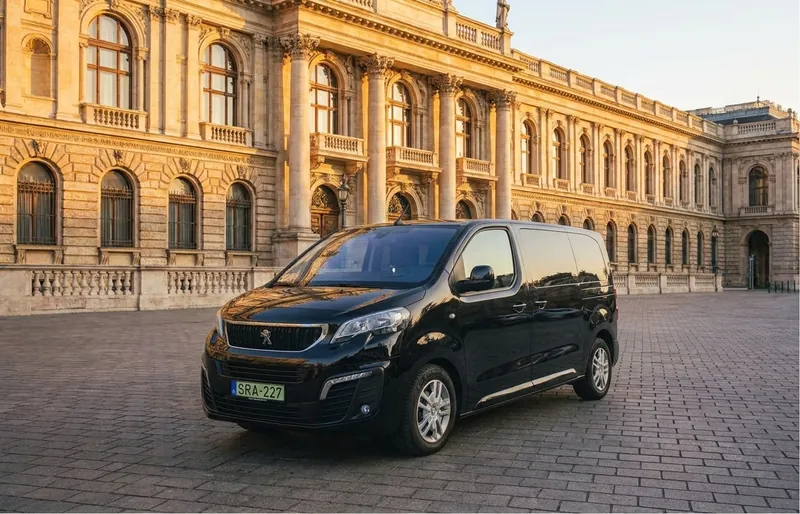
The distinguished guest arrives at the hotel in the EQS, the delegation in the e-Traveller – both with zero local emissions. Airport transfer with Meet & Greet.
Many short legs and frequent waiting – this is where the advantages of electric drive are greatest. For a day like this, an hourly booking is the obvious choice.
Hotel, conference, dinner – group transport for participants in the electric minibus, and for distinguished guests in the electric sedan.
A sample day
On Tuesday morning, the CEO of an international company and five colleagues arrive in Budapest for a two-day partner meeting. The EQS is waiting for the CEO and the e-Traveller for the team at Budapest Ferenc Liszt International Airport: the chauffeurs stand in the arrivals hall with name signs, escort the guests to the cars and drive them to their hotel in the city centre.
In the morning there is a meeting at the partner’s office, at midday lunch on the banks of the Danube, in the afternoon a factory visit just outside the capital, and in the evening a dinner together. The day consists of many short legs and a great deal of waiting – exactly where electric drive has the most to offer: the vehicle waits silently outside the entrance, there is no smell of exhaust when you get in, and on the way you can make calls in peace or prepare for your next meeting.
For the host company, all this means a single quote request, a corporate rate and a single invoice – and the guests travel exactly as they would expect of a partner committed to sustainability goals.
Planning
The real-world range of an electric vehicle is not a single number. Alongside the manufacturer’s figure, temperature, speed, road conditions and air conditioning all play a part: energy consumption is higher in the cold and at sustained high motorway speeds, so the same vehicle covers less distance on a single charge in winter or on a long motorway stretch than in summer in city traffic.
With its long range, the EQS reaches any part of the country or the region in comfort. For a long international journey on a tight schedule – for example, if a return trip to Prague (about 525 km) is squeezed into a single day – it is worth giving us the full route and schedule with your quote request, so that we can recommend a vehicle with this in mind. The e-Traveller is at its best in Budapest and the surrounding area, on airport and city programmes.
| Destination | Distance from Budapest | Travel time (approx.) |
|---|---|---|
| Budapest Ferenc Liszt International Airport | about 16–20 km | 25–60 min |
| Siófok (Lake Balaton) | about 109 km | about 1 h 15 min |
| Eger | about 129 km | about 1 h 30 min |
| Bratislava (Slovakia) | about 200 km | about 2 h |
| Vienna (Austria) | about 245 km | about 2 h 30 min |
Distances and travel times are approximate, for normal traffic and without breaks.
If journey time is the top priority, both electric vehicles have a conventionally powered counterpart in the fleet. The table below contains the details published on our website; transfer fares include tax and parking, hourly rates include tax.
| Electric vehicle | Conventional counterpart | Capacity | Transfer / hourly rate |
|---|---|---|---|
| Mercedes-Benz EQS | Mercedes-Benz S-Class | 3 passengers, 3 pieces of luggage | both €199 / €125 |
| Peugeot e-Traveller | Mercedes-Benz V-Class | 7 passengers, 7 pieces of luggage | €149 / €95 and €179 / €110 respectively |
Questions and answers
Quite the opposite: an electric motor delivers its torque from a standstill, so the vehicle accelerates firmly yet smoothly when pulling away and overtaking. As a passenger, all you notice is that the car moves effortlessly and seamlessly – in town and on the motorway alike.
You can – it is just that the cold reduces the range, as it does for every electric vehicle, because heating the battery and the cabin also takes energy. On the other hand, the cabin warms up quickly, and there is no need to warm up an engine. For longer winter journeys, we allow for this when planning the schedule, which is why we ask you to give us your route in advance.
For city, airport and medium-distance journeys, charging is usually not needed on the way: our base has a solar park and several chargers, so the vehicle can be charged in our own yard between journeys. On a long international journey, a charging stop may form part of the schedule; if that does not fit your programme, we will recommend a conventionally powered vehicle.
With its long range, the EQS lets you travel comfortably to any part of the country or across the region – to a conference on the shores of Lake Balaton or a meeting in Bratislava just as easily as to a dinner in Budapest. The e-Traveller is strongest in the capital and its surroundings, but a shorter excursion into the countryside is also easy to plan with it.
Booking
We accept credit cards. You can request a child seat – an infant seat, a toddler seat or a booster seat – when you book. You can compare our full range of vehicles on the our fleet page.
Booking 24/7
Tell us when, from where to where and how many of you will be travelling, and our team will get back to you with the final quote within a short time.
FAQ
The Mercedes-Benz EQS electric luxury sedan and the Peugeot e-Traveller electric minibus. Both are 100% electric.
The EQS is €199 per transfer (including tax and parking) and €125 per hour (including tax); the e-Traveller is €149 per transfer (including tax and parking) and €95 per hour (including tax).
The EQS takes up to 3 passengers and 3 pieces of luggage; the e-Traveller up to 7 passengers and 7 pieces of luggage.
Yes, just let us know when you book that you would like to travel in the EQS or the e-Traveller.
With its long range, the EQS reaches any part of the country or the region in comfort. For a very long journey on a tight schedule, give us the route in advance so that we can recommend a vehicle with this in mind.
Our base has been extended with a solar park and several electric vehicle chargers, so our electric vehicles can be charged in our own yard.
That the vehicle emits no exhaust gases where it is used. Its overall environmental footprint is also influenced by the source of the energy used for charging.
In Hungary, fully electric cars receive a number plate with a light green background. The benefits associated with it concern the vehicle’s owner and do not affect the price of your journey.
Because travel with zero local emissions is one of the tangible elements of corporate sustainability goals, and a visible signal to guests and partners. We offer our corporate clients a corporate rate and a single invoice.
Read on
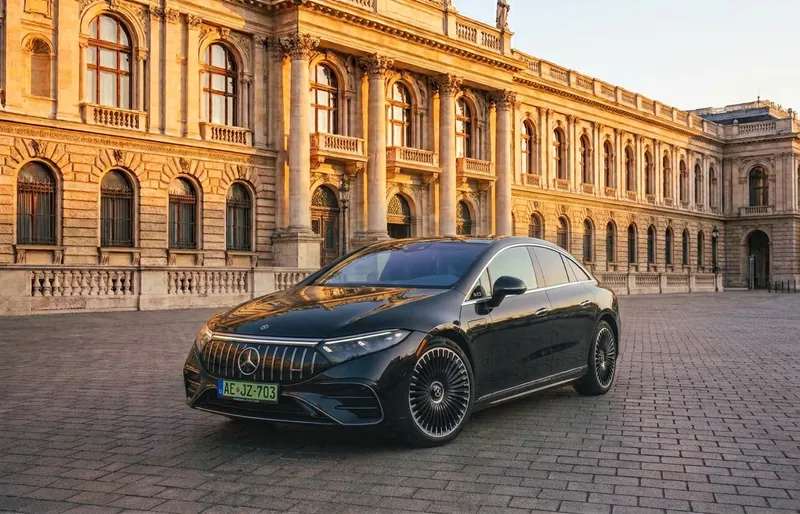 Mercedes-Benz EQS with chauffeur – the electric luxury sedanQuiet luxury with zero local emissions – with the range to reach anywhere in the country.Read more Peugeot e-Traveller with chauffeur – an electric minibus for sevenQuiet, 100% electric, long-wheelbase version with a large boot.Read more
 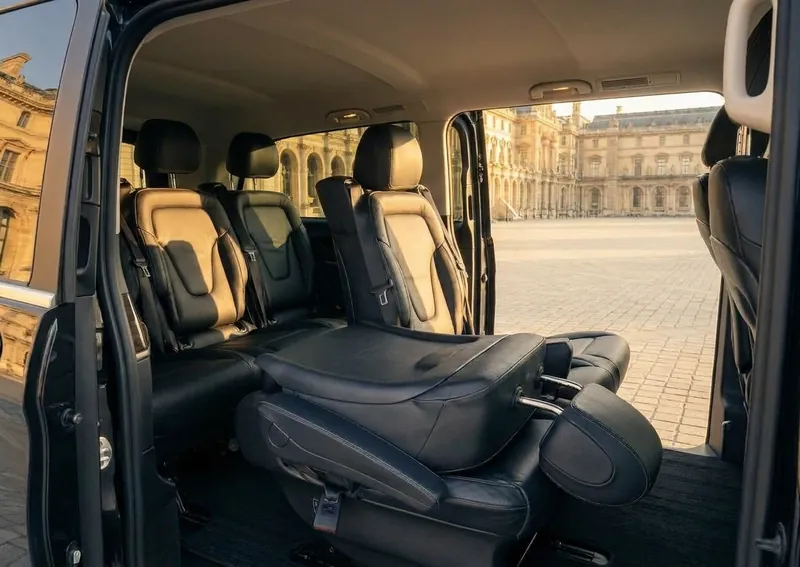 Corporate chauffeur service and delegation transportCorporate rates, one invoice and electronic payment – in Budapest, across Hungary and abroad.Read more
 Booking 24/7
Call us 24 hours a day, or write to us on WhatsApp or by email – we will send you the final quote within a short time.