Luxury
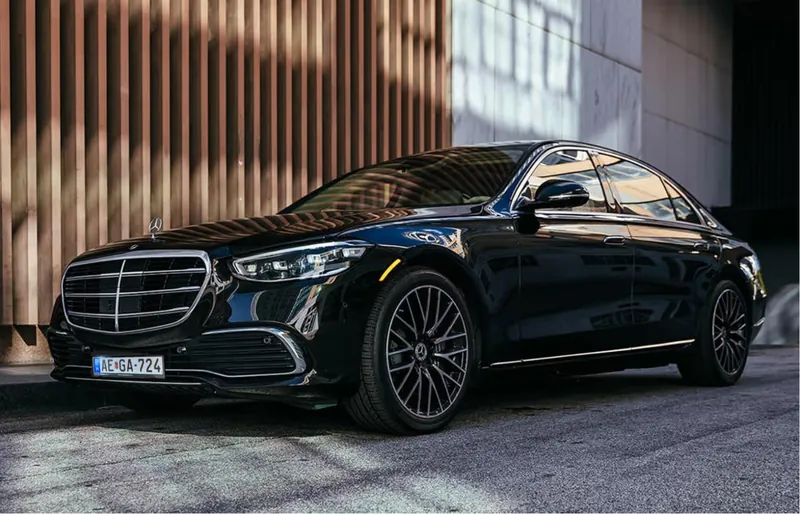
Mercedes-Benz S-Class
- 3 passengers
- 3 bags
- free Wi-Fi
€199 / transfer (incl. tax and parking)
€125 / hour (incl. tax)
About 535 km, five to five and a half hours – motorway all the way, door to door.
Salzburg is further away than it seems: the more than five hundred kilometres from Budapest amount to a full working day behind the wheel if you drive yourself. With a Budapest to Salzburg transfer and a chauffeur, the same journey becomes a relaxed morning or afternoon – for reading, working, talking, or perhaps a good sleep in the back seat.
Mozart’s city, home of the Salzburg Festival and the northern gateway to the Alps, draws many guests from Hungary year after year: music lovers, business travellers, conference delegates and families. We tailor our Budapest–Salzburg transfer specifically to the demands of long motorway journeys: a premium vehicle, an experienced chauffeur, door to door, with no changes. On this page we show you what to expect on the way, what is worth knowing about Salzburg, and which vehicle we recommend for the five to five-and-a-half-hour journey.
Who is it for?
Because of the length of the journey, our guests rarely travel to Salzburg for just one day. We most often see four kinds of trip – each with its own priorities, and each with a different vehicle as the best choice.
An evening at the opera, a concert, a festival week – with an elegant wardrobe, a punctual arrival, and time to rest before the performance.
Negotiations, a conference, a client meeting – five hours in the back seat become productive working time.
A holiday together or an Advent weekend in a single vehicle, with child seats and plenty of room for luggage.
An anniversary, a wedding, a surprise trip – when getting there must be worthy of the occasion too.
The route
The road to Salzburg runs almost entirely on motorways. From Budapest we head west on the M1, past Tatabánya and Győr, and cross into Austria near Hegyeshalom–Nickelsdorf. There we take the A4 East Autobahn (Ost Autobahn) towards Vienna, then the ring that skirts the city to the south – the S1 expressway and the A21 motorway – to join the A1 West Autobahn at Steinhäusl.
The A1 is Austria’s main east–west artery: it runs past St. Pölten, Melk and Linz all the way to Salzburg, and beyond the city it joins the German A8 motorway at the Walserberg border. The total distance is roughly 535 kilometres, and the journey takes five to five and a half hours in normal traffic, a little more with a break.
| Destination | Distance from Budapest | Travel time (approx.) |
|---|---|---|
| Vienna (Austria) | about 245 km | about 2 h 30 min |
| Salzburg (Austria) | about 535 km | about 5 h – 5 h 30 min |
Distances and travel times are approximate, for normal traffic and without breaks.
The ring around Vienna can be busy on weekday mornings and afternoons, so we plan your departure time with this in mind. In the winter season, on changeover days – especially Saturdays – heavy congestion can build up on the Austrian motorways heading into the Alps. In summer, during the festival weeks, traffic moves more slowly in central Salzburg and access is restricted in several places. In winter you should also expect snow; at such times, safety always comes before the schedule.
Hungary and Austria are both Schengen member states, although temporary checks can be introduced at internal borders. Every passenger – children included – should carry a valid identity card or passport. Austria uses the euro, and cards are accepted almost everywhere.
The A1 passes two places where a break can become a cultural experience. The Benedictine abbey of Melk, towering above the Danube, was founded in 1089; its present Baroque ensemble was built between 1702 and 1736 to designs by Jakob Prandtauer, and it forms part of the Wachau cultural landscape, a World Heritage Site. Linz is Austria’s third-largest city and was European Capital of Culture in 2009, while the Ars Electronica Center on the Danube is a renowned centre for media art. You can request an intermediate stop when you book – we will include it in your quote.
Over long distances
On a short city journey, the choice of vehicle is a matter of taste. After five to five and a half hours, however, every detail counts: seat adjustment, sound insulation, legroom, climate control. That is why, for the Salzburg journey, we primarily recommend the vehicles in our fleet designed specifically for long, restful travel.
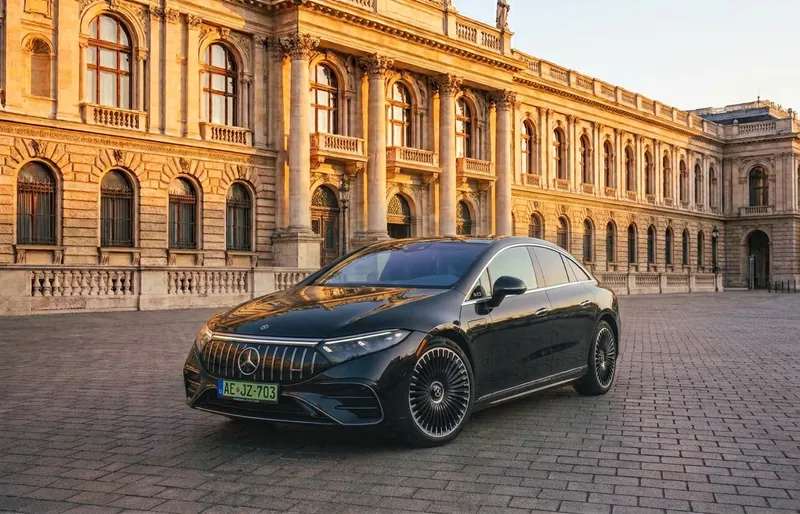
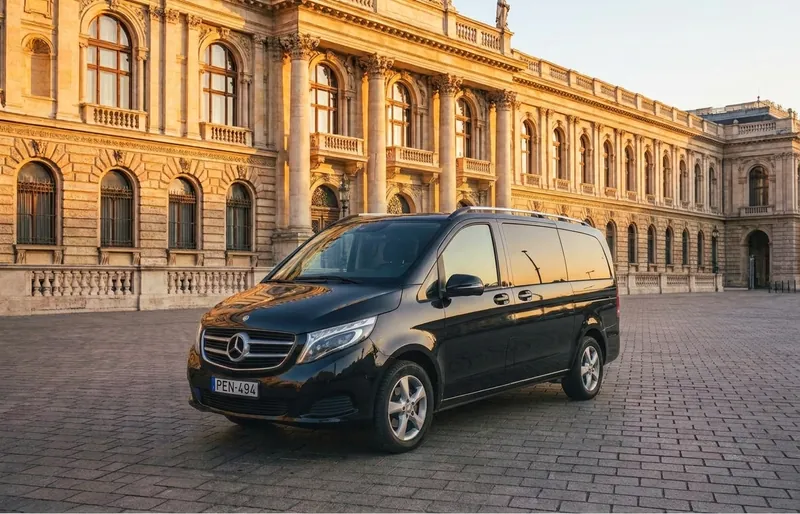
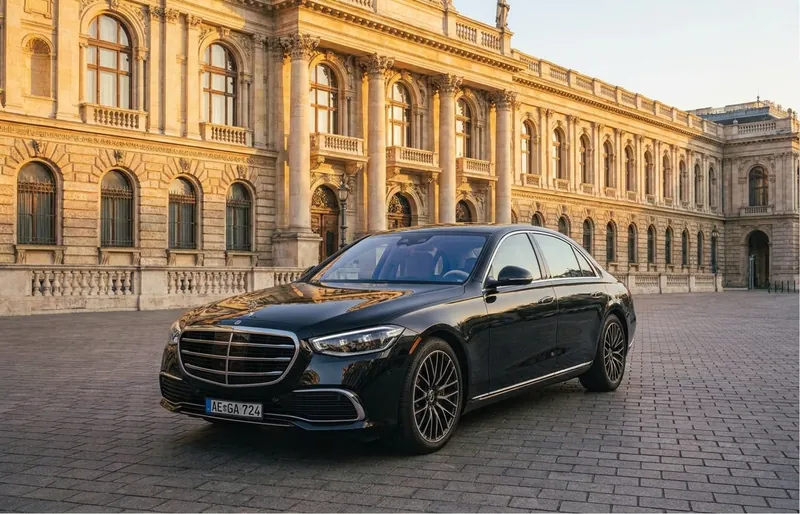
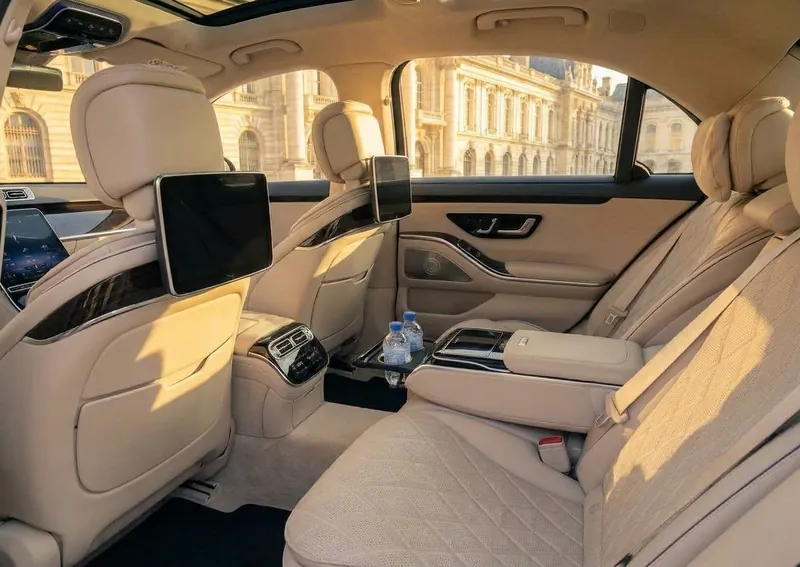
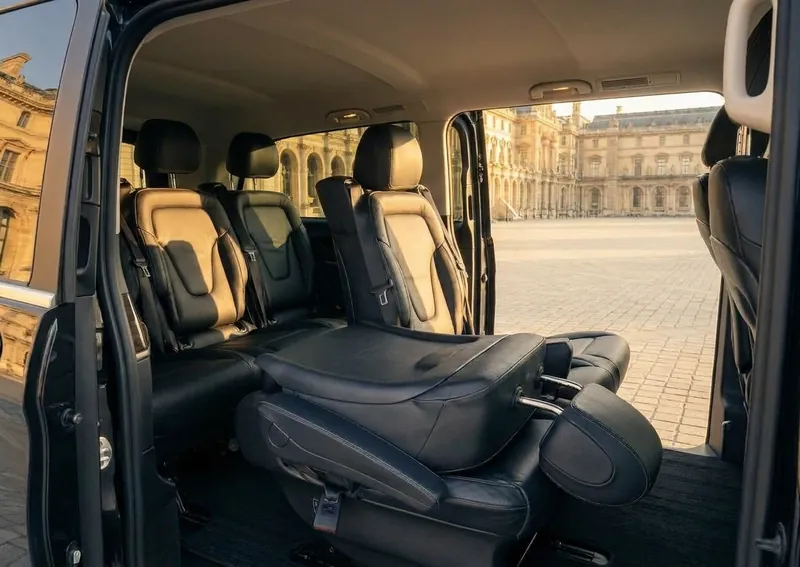
The S-Class is Mercedes-Benz’s flagship sedan: a spacious rear cabin, electrically adjustable heated seats, multi-colour ambient lighting and exclusive materials. The EQS offers the same luxury with electric drive: excellent sound insulation, multi-zone climate control, electrically adjustable seats with massage function, and a long range. If you are travelling with family or a small group, the V-Class, with its premium leather interior and face-to-face seating, offers comfortable room for seven.
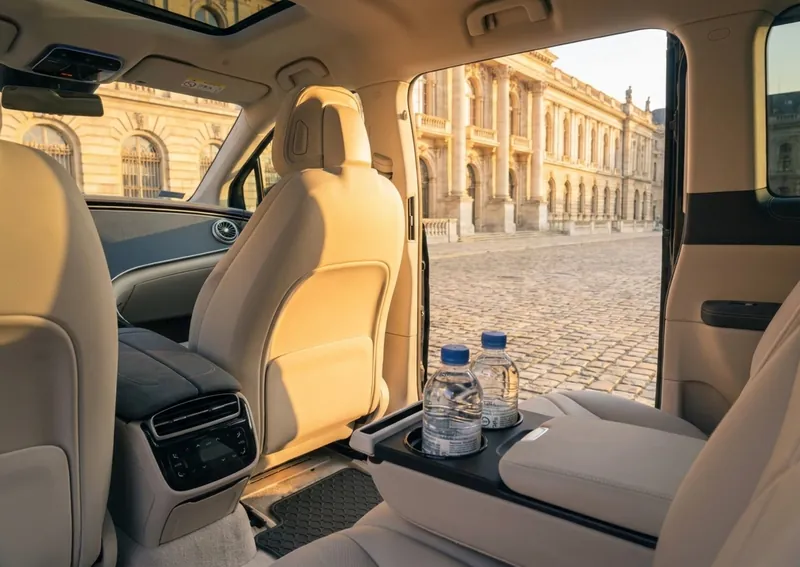
Free Wi-Fi in every car: time enough to work through your emails in the first half of the journey and rest in the second.
Departure at a time of your choosing, breaks wherever you like – no timetables, no changes.
Chauffeurs who speak foreign languages and have years of experience looking after VIP guests.
Music and celebration
For music lovers, the name Salzburg is synonymous with its summer festival. The Salzburg Festival (Salzburger Festspiele) was founded in 1920 by the circle of Hugo von Hofmannsthal, Richard Strauss and Max Reinhardt; the very first performance was Hofmannsthal’s Jedermann, which has been staged every year since on the square in front of the cathedral. The festival takes place every summer from the second half of July to the end of August – some five weeks of opera, concerts and theatre.
The main venues stand close together in the heart of the city: the Großes Festspielhaus, the Felsenreitschule carved into the rock face of the Mönchsberg, and the Haus für Mozart. Beyond the summer festival, the city is a place of musical pilgrimage in spring as well: the Easter Festival (Osterfestspiele) was founded by Herbert von Karajan in 1967, and at Whitsun another festival week awaits audiences.
During the festival weeks, hotels and restaurants are booked up well in advance, traffic in the city centre is slower, and access is restricted in several places. If you are travelling at this time, give us the exact address of your hotel – and, if needed, of the performance venue – when you book. We plan your departure so that you have time to freshen up and change after you arrive: an evening performance waits for no one.
For an evening at the opera in Salzburg, the journey is part of the experience. We make sure our guests arrive rested, on time and in good spirits – the music does the rest.
The city
Salzburg, Austria’s fourth-largest city, lies on the banks of the Salzach, right by the German border. For centuries it was the centre of an ecclesiastical principality ruled by prince-archbishops, and this rich religious heritage shaped its Baroque character today. UNESCO inscribed its historic centre on the World Heritage List in 1996: in the committee’s words, this is where Italian and German culture met, and the townscape has survived almost untouched from the Middle Ages to the 19th century.
The city grew up on the site of Roman Iuvavum, became the seat of an archbishop from 798, and until the early 19th century was the centre of the independent ecclesiastical principality of the prince-archbishops. Wealth from salt mining and the salt trade – the city’s very name refers to salt – made possible the great Baroque building projects of the 17th century, which still define the townscape. Mozart was not only born here; in his youth he also worked here as a musician at the archbishop’s court before moving to Vienna.
The Old Town on the left bank of the Salzach is a maze of narrow lanes, passageways and spacious Baroque squares. The wrought-iron shop signs of Getreidegasse are among the city’s most famous images; Domplatz, Residenzplatz and Kapitelplatz can all be explored on a morning stroll.
Wolfgang Amadeus Mozart was born in the house at Getreidegasse 9 on 27 January 1756. The building has been a museum since 1880, presenting the composer’s childhood, his family and his years in Salzburg.
Founded in 1077, the fortress stands on the summit of the Festungsberg above the city; at around 250 metres long and 150 metres wide, it is one of the largest medieval castles in Europe. The funicular, running since 1892, carries visitors up in comfort, and the bastions offer unrivalled views over the city and the ranges of the Alps.
The palace was built around 1606 on the banks of the Salzach by Prince-Archbishop Wolf Dietrich von Raitenau. With its statues and its view of the fortress, the geometric Baroque garden is one of the city’s best-loved spots; the area around the Pegasus Fountain may look familiar from the film The Sound of Music. The palace’s Marble Hall is now a venue for concerts and weddings.
The Baroque cathedral stands in the middle of the city centre, next to the festival venues; in front of it, on Domplatz, Jedermann is performed every summer.
Across the river, around the Mirabell Gardens and Linzer Gasse, a quieter but equally charming district awaits. From the Makartsteg footbridge – its railings hung with love locks – you get the finest view of the Old Town’s towers and the fortress; at sunset it is one of the city’s favourite photo spots.
Opening hours of museums and sights vary by season – it is worth checking each venue’s own website before you travel.
Business and events
Salzburg is not only a tourist destination: it also hosts conferences, professional events, corporate negotiations and client events. A private transfer is particularly advantageous here for two reasons. First, the five hours become productive working time – in the back seat you can prepare for your meeting, review your presentation or make calls. Second, the team arrives together, at the same time, with no need to coordinate flights, connections or hire cars.
For delegations, the face-to-face seating of the V-Class creates a genuine meeting space, while with lots of luggage, exhibition material or samples, the Sprinter VIP is the right choice: it takes six passengers plus twelve pieces of luggage, with leather seats, a large display and a built-in mini fridge. We offer corporate clients a corporate rate, a single invoice and electronic payment – details on our corporate chauffeur service page.
Seasons
The city is worth visiting all year round, but the two high seasons make for quite different trips. In summer the festival, the garden terraces and the long evenings dominate the city: most of our guests then arrive with an elegant wardrobe, evening engagements and less – but carefully packed – luggage. The S-Class or the EQS is the natural choice at this time of year.
In winter Salzburg also serves as a gateway to the Alps, and during the weeks of Advent the city centre is dressed in festive decorations. This is when there are more large suitcases, winter coats and boots – so it is worth giving us the exact number of bags, so we can suggest a vehicle of the right size. Spring and autumn are quieter: pleasant weather for walking, fewer tourists and more flexibility when booking accommodation.
Whatever the season, we adapt your departure to traffic and weather. A morning departure is the most comfortable: you arrive in the early afternoon, and after checking in there is still time for a stroll through the Old Town or a coffee.
Weighing it up
There is a direct train between Budapest and Salzburg, and many people drive themselves. Both have their place – a private transfer comes into its own when a door-to-door journey, luggage and timing matter most.
| Consideration | Private transfer | Train | Your own car |
|---|---|---|---|
| Departure and arrival | from your Budapest address to your Salzburg hotel | station to station | address to address, with a search for parking |
| Timing | at a time of your choosing | according to the timetable | whenever you like |
| Time on the road | work, rest, sleep | work, rest, keeping an eye on bags | five to five and a half hours of driving |
| Groups and luggage | up to seven passengers or twelve pieces of luggage in one vehicle | carrying bags, onward travel from the station | limited space |
In your own car, you have to drive the whole long way yourself and then hunt for a parking space near Salzburg’s largely pedestrianised Old Town – a challenge in itself during the festival. By train, you still have to get from the station to your hotel with all your luggage. With a private transfer, you take your seat in the back in Budapest and step out at the entrance of your hotel; the time in between is entirely yours.
Fleet
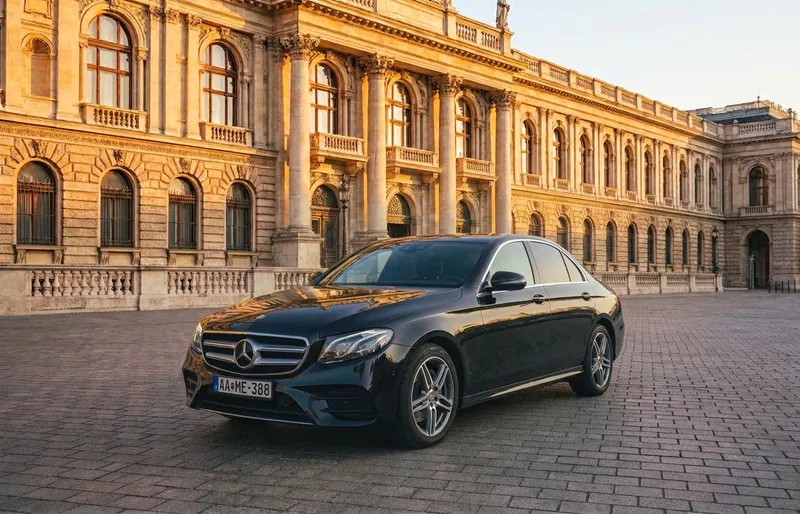
These are the four vehicles we most often recommend for the Salzburg journey. The E-Class is the business middle ground: elegant and comfortable, and suited not only to airport transfers but also to travel within Europe.
Luxury
€199 / transfer (incl. tax and parking)
€125 / hour (incl. tax)
Eco / Luxury · electric
€199 / transfer (incl. tax and parking)
€125 / hour (incl. tax)
VIP minivan
€179 / transfer (incl. tax and parking)
€110 / hour (incl. tax)
Executive
€119 / transfer (incl. tax and parking)
€70 / hour (incl. tax)
The fares shown are the base rates for each vehicle. For a trip to Salzburg we always send a tailored quote based on the vehicle, the exact addresses, breaks and the return journey; we do not publish a fixed price for the route. You will find our full range on the fleet page and a summary of our rates on the Prices and FAQ page. If a day in Vienna is also part of your plans, take a look at our Budapest to Vienna transfer page too.
Planning
Most of our guests spend at least two or three nights in Salzburg: the first day for arriving and an evening stroll, the second for the fortress, the Old Town and Mozart’s birthplace, and the third for a performance or a peaceful morning in the Mirabell Gardens. For a longer stay, you can book the journey home as a separate transfer; if you give us the date in your very first message, our team will send a single quote covering both directions. If you would like to spend an afternoon or a night in Vienna on the way home, let us know – we can plan the route that way too.
Over five hours, plenty of things come out of your bag: a laptop, a charging cable, a book, the festival programme, a cosier jumper. It is worth packing these in a smaller hand bag so you don’t need to reach into the boot. Mineral water awaits our passengers in every car, and we are happy to arrange any further requests. Keep your documents, bank card and hotel booking details to hand; if your hotel check-in time is fixed, tell us so that we can plan your departure around it.
You can read about the booking process and the details we need on our booking and quotes page. You will find our other destinations in our international transfers overview. Salzburg also features in our leisure programmes – if you are planning sightseeing alongside your transfer, mention it when you book.
FAQ
In normal traffic, roughly five to five and a half hours; the distance is about 535 kilometres, almost all of it on motorways.
On the M1 to Hegyeshalom, then in Austria on the A4 towards Vienna, skirting the city to the south on the S1 and A21 to join the A1 West Autobahn, and on past St. Pölten and Linz to Salzburg.
Yes. Request the intermediate stop when you book, and we will include it in your quote.
Every summer, from the second half of July to the end of August. At this time it is worth booking accommodation and tickets well in advance.
For one to three passengers, the S-Class or the electric EQS; for up to seven people, the V-Class; and with plenty of luggage, the Sprinter VIP.
Not necessarily: Austria is a Schengen member state, so a valid identity card is enough. Temporary checks may take place, so every passenger should carry their document.
For a trip to Salzburg we send a tailored quote based on the vehicle, the addresses and the stops. You will find the base rates for our vehicles on the Prices and FAQ page.
By phone day or night, on WhatsApp or by email. Our team will come back to you shortly with a final quote.
Read on
 Budapest to Vienna transfer – door to door with a driverAbout 245 km, two and a half hours – even a business day in Vienna and back fits in comfortably.Read more Mercedes-Benz S-Class with chauffeur – VIP and protocol travelThe brand's flagship sedan for distinguished guests, executive travel and special occasions.Read more
  Corporate chauffeur service and delegation transportCorporate rates, one invoice and electronic payment – in Budapest, across Hungary and abroad.Read more
 Booking 24/7
Send us the date, addresses, number of passengers and any breaks you would like – our team will come back to you shortly with a tailored quote for the Budapest–Salzburg journey.